
Automate intake, keep human judgment
A decision guide for business leaders: automate request preparation, preserve source evidence, give human reviewers clear ownership, and measure the stage that actually changed.
Last reviewed October 7, 2026
The executive decision
A useful first automation removes preparation work from a decision people already understand. It collects a request, organizes the evidence, identifies missing information, and puts a review-ready packet in front of an accountable person. The reviewer still decides what happens next. This gives a business a bounded place to test value without transferring commercial judgment to an unattended workflow.
Start with one request type, one review packet, and one named decision owner. Expand only when the packet is trustworthy and the handoff works.
Three takeaways: preserve the original evidence; make incomplete requests visible; and measure preparation, review, and decisions separately. Faster intake is useful only when it improves the work that follows.
This is a sample editorial guide. The workflow and measures below are a proposed operating model, not a report of measured client results.
Choose a bottleneck the business can recognize
Requests often arrive through email, forms, spreadsheets, or shared folders. Someone reads them, searches for related documents, copies facts into another system, and asks colleagues what is missing. That preparation may consume attention before a qualified person can assess the opportunity. The first question is therefore practical: which repeated preparation step delays a useful decision?
Consider a bid-intake scenario. A request may include a project name, location, response deadline, attachments, and a partial description of the work. Preparing it for an estimator is different from estimating it. The packet can organize supplied information and flag gaps; it cannot establish an accurate price from facts that were never provided.
Select a request type with recognizable inputs and a clear review destination. Examine representative recent requests, including awkward cases. Agree what a useful packet contains and what a reviewer must still verify. If reviewers disagree about basic acceptance criteria, clarify those criteria before encoding the workflow.
Define a review-ready packet
A review packet should let someone inspect the request without reconstructing its history. Include the original source, received time, relevant deadline, supplied facts, document links, missing fields, and the responsible reviewer. Distinguish information explicitly provided by the requester from anything inferred during processing. An empty field is more honest than a confident guess.
Keep the source next to each consequential fact. If a date was extracted from an attachment, retain a link and enough context to check it. Preserve the original file and message rather than replacing them with a summary. The summary helps the reviewer navigate; the source allows the reviewer to verify.
Define readiness through required evidence, not through a successful automation run. A packet can be technically created yet still be unusable. Missing scope, inaccessible attachments, conflicting deadlines, or an unknown customer should have visible states and an owner who can resolve them. Avoid a single completed label that hides these differences.
Make the human handoff explicit
Automation can collect a request, normalize consistent fields, prepare a checklist, and route the packet. A person should verify consequential facts and decide whether to proceed, request more information, or decline. Those are distinct responsibilities. A routing rule does not become an approval rule simply because both happen inside the same application.
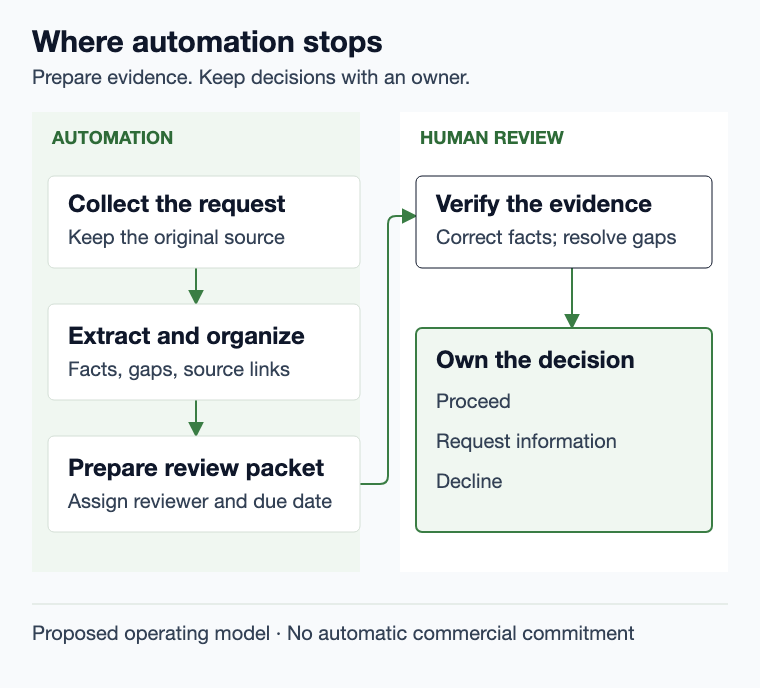
Assign the reviewer before the request becomes invisible in a queue. Give that reviewer a due time, access to the evidence, and a way to record corrections and the decision. If the normal reviewer is unavailable, define the escalation destination. A dashboard showing hundreds of packets is not an operating model unless someone knows which ones they own.
If AI is used to extract or summarize information, treat the output as a candidate interpretation. Review uncertain or consequential facts against the source. Do not silently convert an uncertain extraction into an authoritative business record. A confidence label can help triage, but it cannot substitute for the evidence needed to make the decision.
Decide what happens when information is missing
Design the exception path before the happy path becomes the only path. A request may be duplicated, amended after submission, sent without an attachment, or delivered with an unreadable file. Each case needs a visible status, a responsible person, and a next action. It should remain possible to resume the work after the missing information arrives.
Duplicates should be linked and reviewed rather than automatically discarded when the matching rule is uncertain. An amended scope should preserve the earlier packet and identify what changed. A failed delivery to a reviewer should stay pending and alert its owner. These controls reduce the chance that an automation makes work disappear while reporting that it succeeded.
Keep a manual route available during the pilot. Reviewers should be able to inspect the source and record a decision when extraction or routing fails. Record that intervention so the team can learn from it. If the manual route is constantly required, the result is evidence about the workflow’s limits and a reason to revise its scope.
Measure the step that actually changed
Before the pilot, define the start and end of each measure. Preparation time runs from receipt to a review-ready packet. Waiting time runs from readiness to the start of review. Correction effort captures the work needed to repair missing or incorrect information. Decision turnaround ends when the accountable person records a disposition.
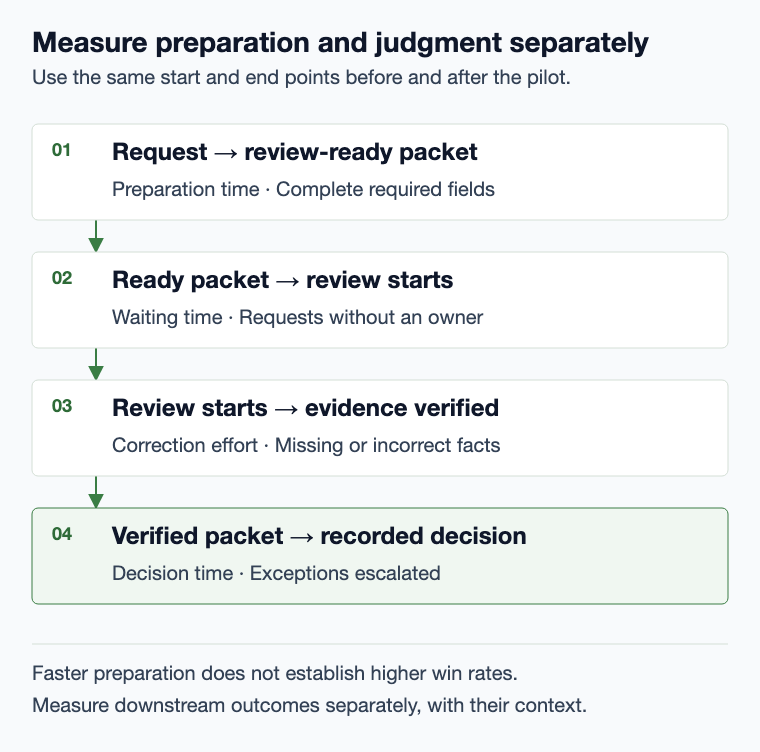
Compare comparable requests and retain their context: request complexity, completeness, reviewer availability, and unusual deadlines can change the result. Inspect individual exceptions as well as overall summaries. A faster average can hide a small group of requests that now wait longer or arrive with weaker evidence.
Track the quality of the packet alongside speed. Useful signals include completeness of required fields, facts corrected by reviewers, inaccessible source links, and requests without an owner. Set acceptable thresholds with the people doing the work before the pilot begins. The guide proposes these measures; it does not prescribe universal numerical targets.
Treat commercial outcomes as a separate question. Shorter preparation does not prove higher win rates, better pricing, or more profitable work. Those outcomes also depend on qualification, capacity, customer needs, competition, and execution. Make a claim about them only when the business has relevant evidence and a defensible comparison.
Run a bounded pilot before expanding
Begin with one request source and a deliberately small set of fields. Run the workflow alongside normal review, inspect every packet, and record where people correct it. Include incomplete and amended requests in the pilot. A workflow tested only on clean examples gives little information about the operating conditions it will face.
Agree the expansion conditions in advance: trustworthy evidence, reliable ownership, manageable correction effort, and a useful change in the selected preparation step. Agree stop conditions too, such as lost source information, misrouted sensitive requests, or unresolved exceptions. Keep the next expansion specific—a second request type or a new source—so its added complexity can be assessed.
The same approach applies to software maintenance intake, support triage, and operational approvals. Choose one recurring preparation task, keep the consequential decision with its owner, and verify the handoff. The reusable lesson is the boundary between organizing information and deciding what that information means for the business.
A checklist for the next planning conversation
Ask the process owner: Which request type are we starting with? What makes its packet review-ready? Where is the original evidence? Who verifies it and records the decision? How do missing information, amendments, and unavailable reviewers get handled? Which preparation and quality measures will determine whether the pilot is useful?
Bring representative requests and the people who currently prepare and review them to that conversation. End with an agreed packet, an owner, an exception path, and a measurement plan. Those artifacts make the first automation concrete enough to evaluate and small enough to improve.
Further reading
Read the companion sample case study: from bid intake to estimator-ready opportunities.