
In fast-paced digital businesses, project estimation is often misunderstood as a technical task. In reality, it is a strategic business discipline that directly influences budget planning, delivery timelines, team alignment, and customer trust. At SMW Music Academy and across our modernization initiatives, estimation has evolved from “how long will it take?” to a mature, predictable framework for decision-making. This article breaks down how organizations can use estimation as a business advantage, not just a technical exercise.

1. Why Accurate Estimation Matters to the Business
Project estimation determines the three pillars of every successful project:
1. Budget Confidence
Leaders need to know:
How much investment the project requires
Whether the ROI justifies the cost
What the financial exposure or risk is
Without strong estimation, budgets become guesswork.
2. Delivery Predictability
Your customers, internal teams, and stakeholders rely on:
Milestones
Timelines
Launch schedules
Operational planning
Estimation makes delivery timelines realistic, not overly optimistic.
3. Scope and Expectations Alignment
Estimation connects:
What the business wants
What the engineering team can deliver
Within what constraints
It prevents disputes, surprises, and uncontrolled scope creep.
2. The Hidden Costs of Poor Estimation
Project Information
Client:
Maurizio
Location:
Canada
Project duration:
3 -6 Months
Technologies used:
Nextjs, Nestjs
Website:
https://arcadiaacademyofmusic.com/
Many companies underestimate how expensive “bad estimation” can be.
Consequences:
Over-budget delivery
Missed deadlines
Losing customer trust
Burnout among teams
Project cancellations
Revenue loss
Wasted months of engineering effort
This is why estimation is not optional — it is a form of business risk management.
3. The Estimation Workflow (Business-Level View)
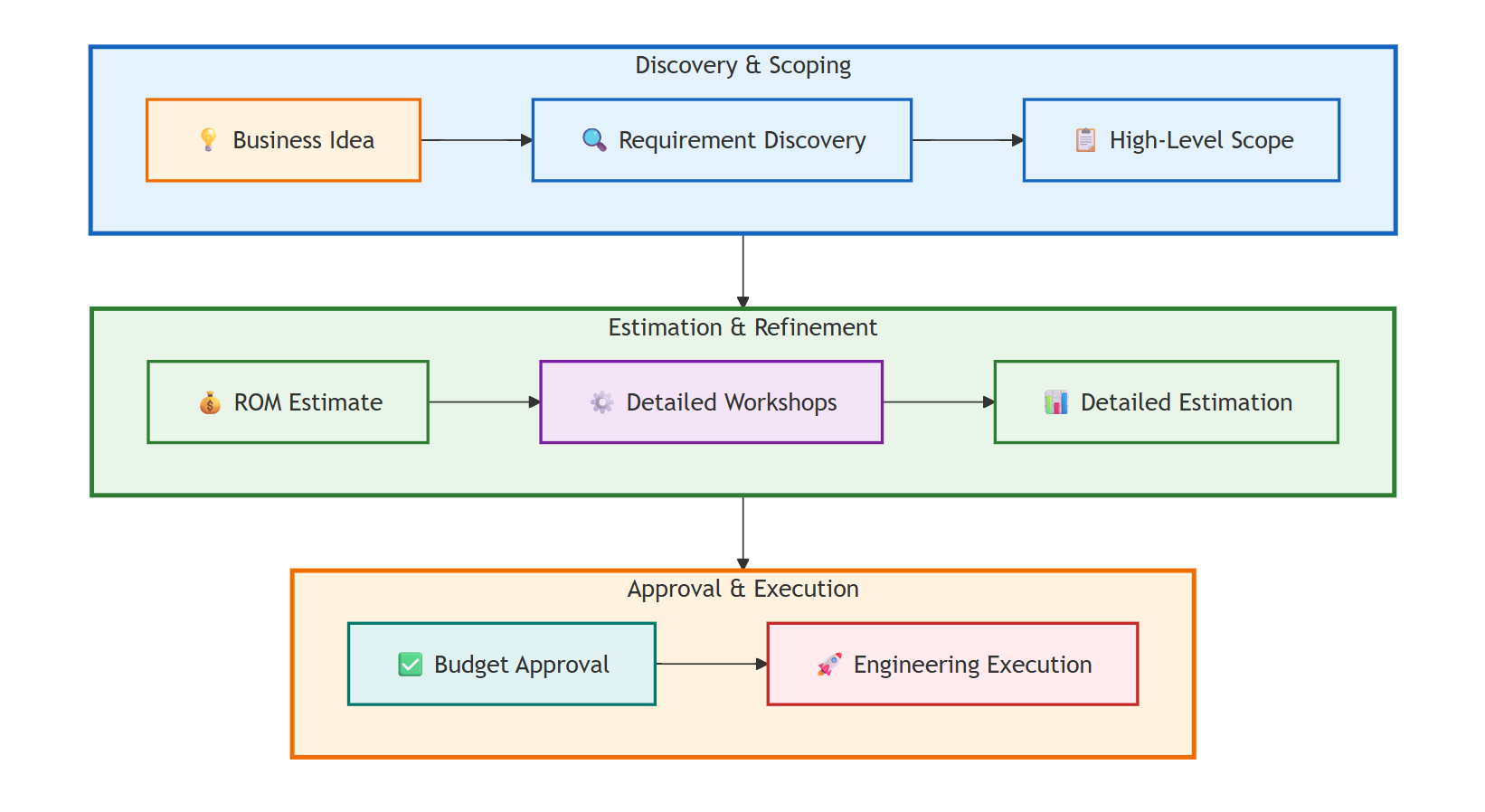
Below is a business-friendly visual map of how estimation should flow in a modern organization.This workflow ensures that estimation is progressive - becoming more accurate as information matures.
4. The 3 Levels of Estimation
We use a multi-stage estimation approach, where accuracy increases over time.
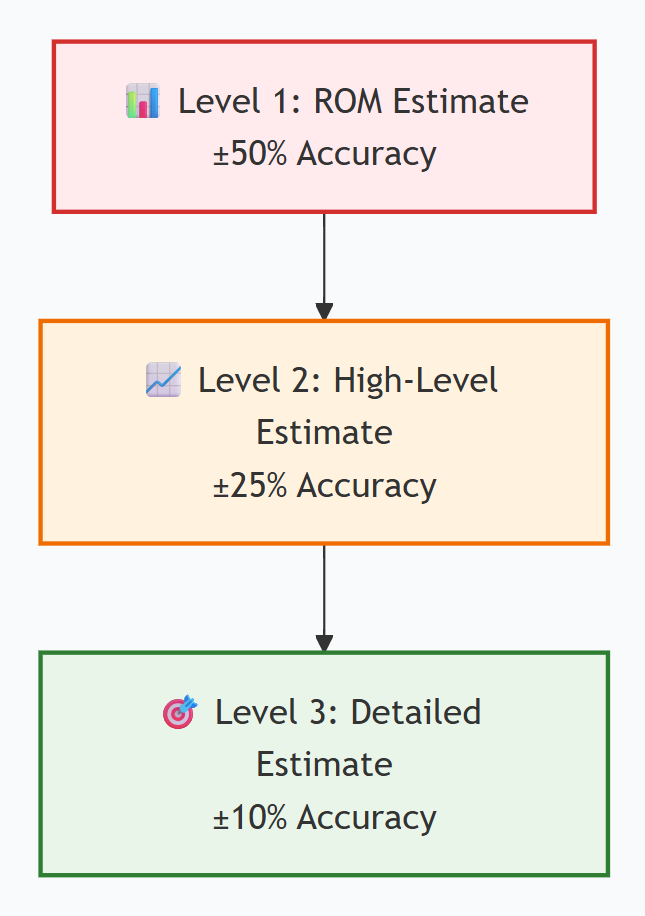
Level 1: ROM (Rough Order of Magnitude)
Purpose: Decide “Should we invest or not?”
Based on assumptions
Very fast (hours)
Used in budgeting & prioritization
Level 2: High-Level Estimate
Based on refined requirements
Uses components, modules, and complexity
Good for planning quarterly or monthly roadmaps
Level 3: Detailed Estimate
Deep analysis of user flows, APIs, UX, integrations
High accuracy needed for fixed-scope delivery
Best used after approval and discovery workshops
5. The Estimation Triangle
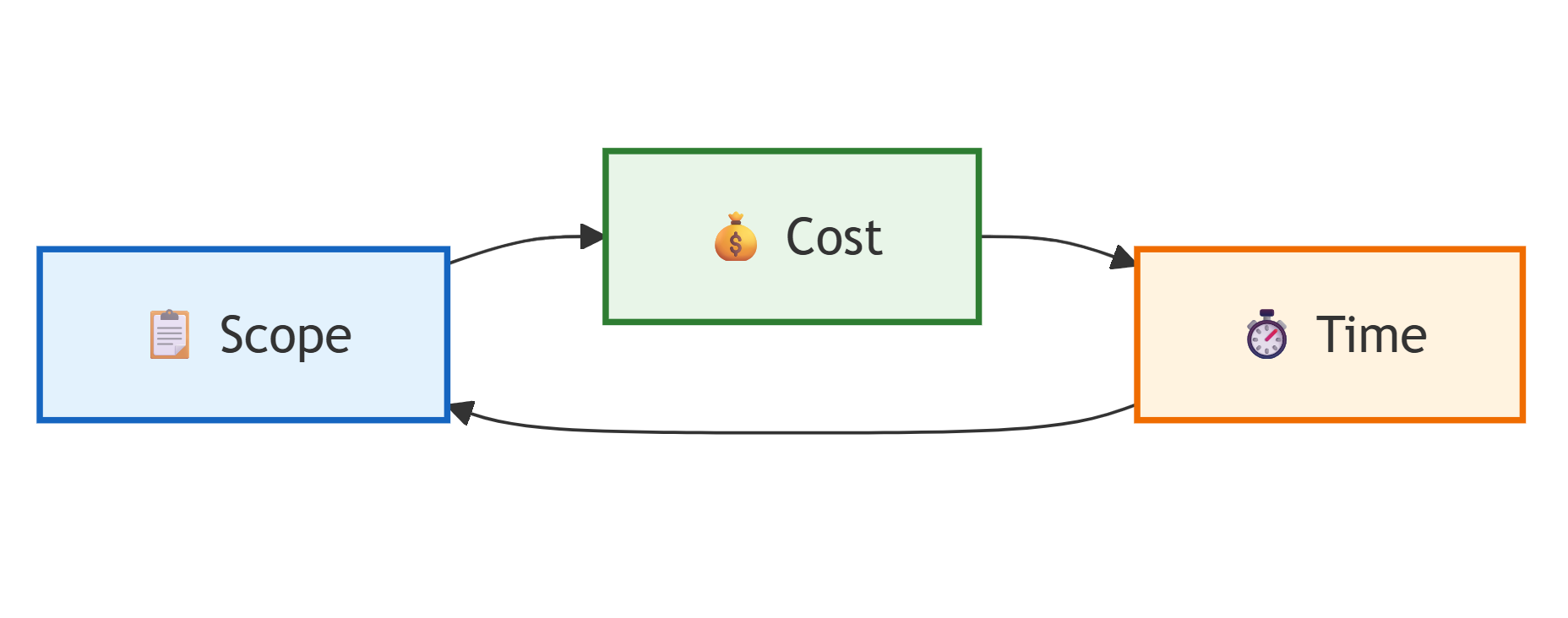
Every project is governed by three constraints: Changes to one always impact the others.
6. Business-Focused Estimation Techniques
1. T-Shirt Sizing (Business-friendly)
S, M, L, XL
Helps leadership understand relative effort
No hours involved
Useful in: feature prioritization, early discussions.
2. Component-Based Estimation
Breaks the system into:
Modules
Pages
APIs
Integrations
Each piece receives a size or time estimate.
3. Risk-Based Adjustments
Every project has uncertainties:
Legacy dependencies
Third-party integrations
New technologies
Undefined requirements
We add buffers (10%–30%) based on risk level.
4. Weighted Effort Calculation (Example)
Here’s the only code-like snippet included, and it’s business-friendly:
Final Estimate = (Base Effort) + (Risk Buffer) + (Review & Testing)
This ensures the estimate is not only about writing code, but also:
QA
Reviews
DevOps
Deployment
Support readiness
7. How Estimation Reduces Business Risk
1. Early Budget Visibility
Finance & leadership can allocate funds properly.
2. Faster Decision-Making
ROM estimates allow quick go/no-go decisions.
3. Better Roadmap Planning
Accurate estimates = predictable releases.
4. Resource Optimization
Knowing effort helps decide:
Hiring
Outsourcing
Prioritization
Timeline balancing
5. Reduced Delivery Failures
Projects stay on track with fewer escalations.
8. A Real-World Estimation Scenario
Problem
Team must migrate legacy system to a modern API architecture.
Estimation Flow
ROM: 6–8 weeks
After discovery: 4 modules identified
Detailed estimate: 9.5 weeks
Business adjusts the scope to fit 8-week timeline
Approved → execution begins
Outcome
No surprises
Clear expectations
Fixed cost and timeline
High stakeholder confidence
9. Best Practices for Business Leaders
✔ Always request a ROM first
Don’t ask for “final estimates” before discovery.
✔ Encourage requirement clarity
Ambiguous requirements = inaccurate timelines.
✔ Accept that estimation evolves
Accuracy grows with information.
✔ Separate scope from solution
Let engineering decide how to implement.
✔ Budget for risk
Technology has unknowns — prepare for them.
10. Conclusion
Estimation is not a technical opinion – it is a strategic business tool.
Used correctly, it creates:
Visibility
Predictability
Confidence
Controlled budgets
Better outcomes
With a structured estimation framework, organizations can avoid execution pitfalls, make smarter investments, and deliver products on time and within budget.