

Process & Strategy
Multi-Level Project Estimation Framework for SMW Music Academy
How a structured, multi-level estimation framework transformed project planning from guesswork into a strategic business discipline, improving budget confidence, delivery predictability, and stakeholder trust.
Project Overview
In fast-paced digital businesses, project estimation is often misunderstood as a purely technical task. In reality, it is a strategic business discipline that directly influences budget planning, delivery timelines, team alignment, and customer trust. For SMW Music Academy's modernization initiative, we developed a multi-level estimation framework (spanning ROM, high-level, and detailed estimates) with T-shirt sizing, component-based analysis, and risk-adjusted buffers that transformed "how long will it take?" into a mature, predictable decision-making process.
The Estimation Workflow
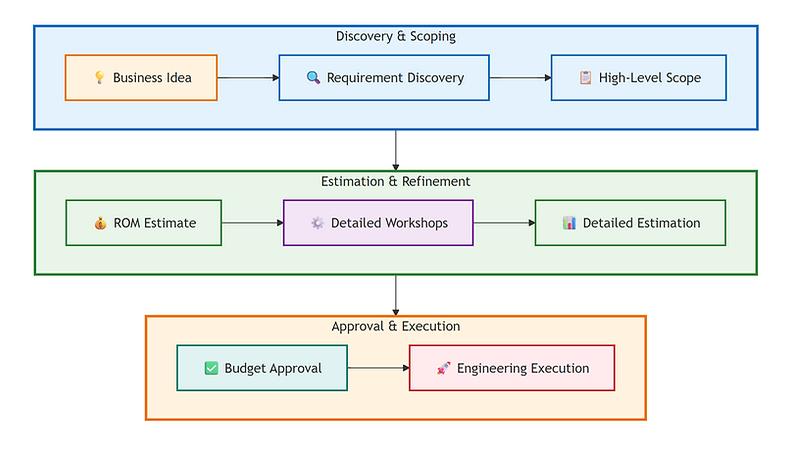
Estimation is not a one-time activity, it is a progressive refinement process. Starting from a Rough Order of Magnitude at the discovery stage, estimates are refined as requirements become clearer, passing through high-level component analysis and arriving at detailed, risk-adjusted delivery forecasts before work begins.
The 3 Levels of Estimation
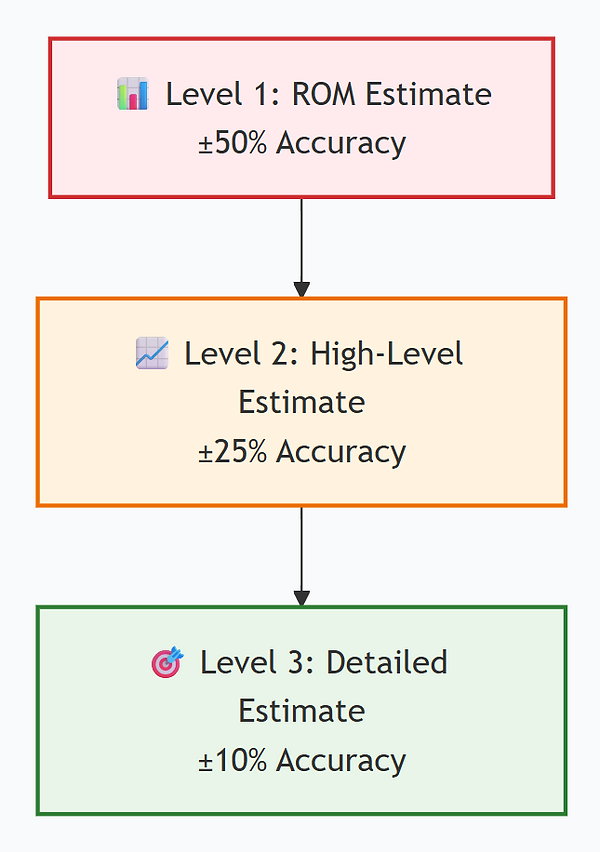
Each level of estimation serves a distinct business purpose. ROM estimates support go/no-go investment decisions and can be produced in hours. High-level estimates inform quarterly roadmap planning. Detailed estimates provide fixed-scope delivery confidence, with risk buffers and weighted effort calculations applied based on known unknowns.
The Estimation Triangle
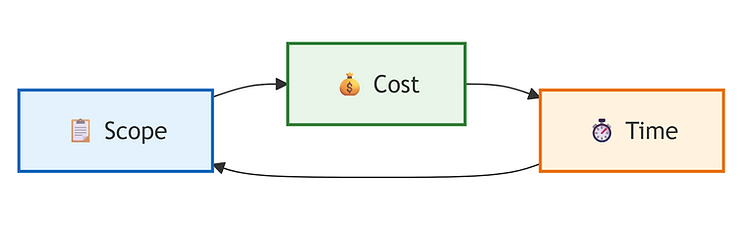
Every project operates within the constraints of scope, time, and cost. The Estimation Triangle makes this relationship explicit: when one variable changes, the others must adjust. Understanding this triangle allows leadership to make informed trade-offs rather than discovering conflicts mid-delivery.
Client Objectives
The engagement was guided by clear objectives that defined success for business leadership and delivery teams.
Establish Budget Confidence
Create a multi-level estimation framework that gives leadership reliable cost projections at each decision stage.
Achieve Delivery Predictability
Produce realistic timelines backed by progressive refinement, from ROM through detailed estimation.
Quantify and Manage Risk
Introduce risk-adjusted buffers and weighted effort calculations to account for unknowns before they derail delivery.
The challenge
Complex constraints hindering growth
Budget Uncertainty
Without a structured estimation process, project budgets were based on guesswork, leading to over-budget deliveries and stakeholder distrust.
Unpredictable Timelines
Lack of progressive estimation meant deadlines were set optimistically rather than realistically, causing frequent missed milestones.
Scope Creep Risk
Insufficient alignment between business requirements and engineering capacity left projects vulnerable to uncontrolled scope changes and disputes.
Hidden Risk Exposure
Legacy dependencies, third-party integrations, and undefined requirements introduced unquantified risk that surfaced only during execution.
The solution
Multi-Level Estimation Framework
A progressive estimation approach treating project estimation as a strategic business discipline, not just a technical exercise.
ROM (Rough Order of Magnitude)
Fast, assumption-based estimates produced in hours to support go/no-go investment decisions. Used for early budgeting and prioritization before detailed requirements exist.
- Investment Decisions
- Budget Planning
- Quick Assessment
High-Level Estimation
Refined estimates based on identified components, modules, and complexity. Supports quarterly and monthly roadmap planning with increased accuracy.
- Component Analysis
- T-Shirt Sizing
- Roadmap Planning
Detailed Estimation
Deep analysis of user flows, APIs, UX, and integrations. Applies risk-adjusted buffers and weighted effort calculations for fixed-scope delivery confidence.
- Risk Buffers
- Weighted Effort
- Fixed-Scope Delivery
Estimation Validation & Alignment
Cross-functional review ensuring estimates account for QA, DevOps, deployment, and support readiness, aligning business expectations with engineering capacity.
- Scope Alignment
- Cross-Functional
- Stakeholder Review
Technologies Implemented
- Next.js
- NestJS
- 3
- Estimation Levels
- 10-30%
- Risk-Adjusted Buffers
- 3-6 mo
- Project Duration
- High
- Stakeholder Confidence
Business impact
Strategic Business Outcomes
Estimation transformed from a guessing exercise into a reliable decision-making framework.
Budget Control
- Accurate
- Cost projections at each stage
- Reduced
- Over-budget delivery risk
Delivery Predictability
- Realistic
- Milestone timelines
- Faster
- Go/no-go decisions via ROM
Risk Management
- Quantified
- Risk exposure before execution
- Aligned
- Business and engineering expectations
How we drive results
Turning Strategy into Measurable Business Impact
Our case studies reflect a consistent delivery model focused on outcomes, helping organizations modernize technology, reduce risk, and accelerate growth through practical, scalable solutions.
Outcome-Driven Strategy
Every engagement starts with clear business objectives, success metrics, and a roadmap aligned to real operational and financial outcomes.
Proven Execution Model
We apply proven frameworks, agile delivery, and industry best practices to execute complex initiatives with speed, quality, and predictability.
Secure & Scalable Delivery
Our solutions are built with security, compliance, and scalability at the core, ensuring long-term resilience and sustainable growth.
Ready to Make Estimation Your Strategic Advantage?
From rough estimates to predictable delivery, let us build an estimation framework that gives your business confidence at every stage.
Talk to Us